
Clear information for a more prepared visit
Supervised visitation can feel unfamiliar at first. These resources explain the purpose of supervision, the monitor’s role, ways adults can support children, and practical steps that help visits remain structured, child-focused, and easier to understand.
What is supervised visitation?
Supervised visitation is structured contact between a child and a parent or other approved person while a trained third party remains present. The supervisor observes the visit, supports required boundaries, intervenes when necessary, and prepares documentation in accordance with the service agreement and case requirements.
Supervision does not automatically mean that abuse or neglect occurred. It may be ordered or agreed upon for many reasons, including safety concerns, a long interruption in contact, high parental conflict, substance-use concerns, family violence allegations, mental-health considerations affecting parenting, or the need for a gradual transition toward less restrictive contact.
Every family’s circumstances are different
A court, agency, or family may use supervised contact when additional structure or observation is considered appropriate. The reason and required conditions depend on the facts of the case and the governing order or agreement.
Safety Concerns
Allegations or documented concerns involving family violence, abuse, neglect, unsafe conduct, or an unsuitable environment may lead to supervised contact.
Substance-Use Concerns
Supervision may provide additional structure while a parent addresses alleged or identified substance use, treatment, testing, or recovery-related requirements.
Interrupted Contact
When a child and parent have had limited or no recent contact, supervision may support a gradual and more predictable reintroduction.
High Conflict
A neutral professional may help maintain boundaries and reduce the child’s exposure to adult conflict during parenting time or exchanges.
Parenting or Mental-Health Considerations
Supervision may be used when current functioning, behavior, or parenting needs require added structure, observation, or support.
Transitions and Step-Up Plans
Supervised contact may serve as one stage in a court-directed or agreed plan intended to evaluate progress or move toward different contact arrangements.
Understanding the visit supervisor’s role
The supervisor supports the integrity of the visit through active awareness, neutral observation, clear boundaries, appropriate redirection, and action when a significant safety or compliance concern arises.
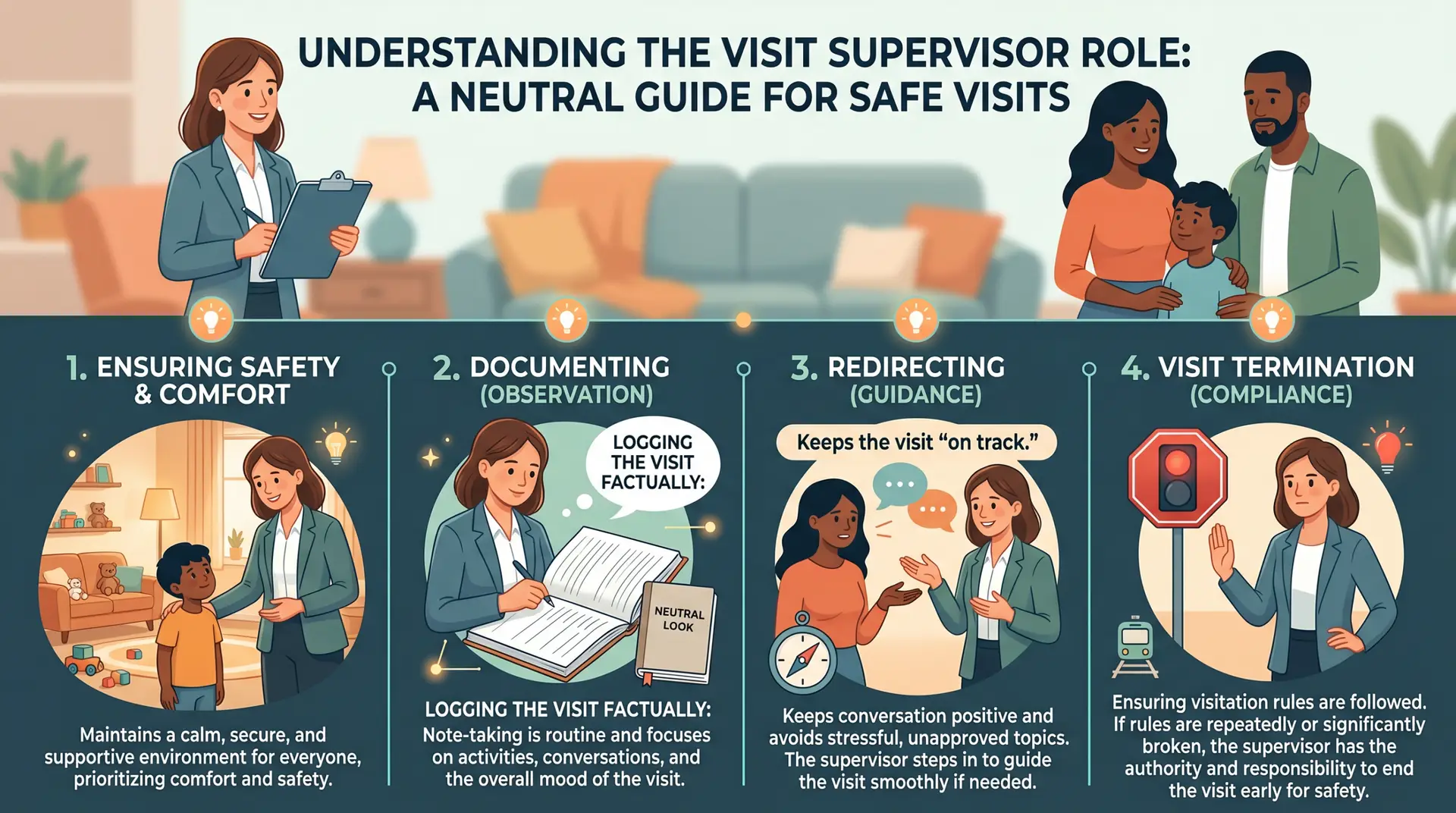
Remains attentive to the child, participants, environment, boundaries, and observable concerns throughout the scheduled contact.
Records relevant activities, statements, interactions, interventions, and events without diagnosing participants or deciding custody.
Provides clear guidance when conversation, conduct, or activity moves outside approved visitation expectations.
May pause or end contact when required by safety needs, significant rule violations, the governing order, or company procedures.
Resources created for parents and children
Our books give families age-appropriate language, practical preparation tools, and compassionate guidance for navigating supervised parenting time.

Bridging the Gap
A Parent’s Guide to Navigating Supervised Visitation with Compassion and Confidence
A practical guide for supervised and non-supervised parents who want to understand the process, prepare thoughtfully, and remain focused on their child’s needs.
- How supervised visitation works
- Community, in-home, and virtual visits
- Communication and preparation tools
- Worksheets for planning and accountability

The Special Visit Day
A Picture Book to Help Children Understand Supervised Parenting Time
A gentle, child-centered picture book that introduces supervised parenting time using reassuring language and a predictable view of what a special visit may look like.
- Helps make an unfamiliar process easier to understand
- Introduces the visit supervisor in a neutral way
- Supports preparation without making promises
- Designed for shared reading with a trusted adult
Helping the visit begin with less uncertainty
Children benefit when adults keep explanations simple, avoid promises, and follow the approved plan consistently. Case-specific instructions always control over general guidance.
For the Visiting Parent
- Arrive prepared and follow all arrival, identification, and location instructions.
- Bring only approved food, gifts, activities, and other items.
- Focus on the child rather than the court case or adult disagreements.
- Accept redirection promptly and ask procedural questions outside the child’s presence.
For the Other Parent or Caregiver
- Use neutral, simple language when explaining the visit.
- Avoid questioning the child afterward or asking the child to report on the other parent.
- Follow exchange, privacy, communication, and departure instructions.
- Send required supplies and timely information about the child’s immediate needs.
Helpful Language for Children
- “You are going to spend time with your parent.”
- “A visit supervisor will be there during the visit.”
- “The adults have planned where the visit will happen.”
- “You can ask the supervisor if you need help during the visit.”
Common family questions
Does supervision mean the visiting parent is dangerous?
No single conclusion can be drawn from the existence of supervision. It may be used for many reasons, and Secure Family Visits does not determine whether allegations are true or make findings about a parent.
Will the supervisor tell the court who should have custody?
No. Secure Family Visits provides neutral supervision and objective documentation. The court, not the visitation supervisor, makes custody and parenting-time decisions.
Can an in-home visit begin as soon as a supervisor is available?
No. In-home visits require the applicable intake and case review, completion and approval of the required home safety assessment, scheduling, payment, and qualified monitor availability.
Who receives visitation reports?
Reports are delivered to authorized recipients in accordance with the court order, service agreement, company policy, and case-specific requirements. Reports are not automatically sent directly to a court unless an authorized process requires it.
Can the monitor change the court-ordered visitation terms?
No. Secure Family Visits does not modify or resolve disputes concerning a court order. The company applies the order and service requirements within its professional role. Disputed interpretations must be addressed by the parties, counsel, or the court.
Need help understanding how services begin?
Review the intake process, current fees, and service requirements—or submit an inquiry so our team can review the requested service and location.